Giants
of the Far North; Giantism or Acromegaly ---Page 17

We note that the discovery of "Giant" remains in around
1930 was written up in the scientific journals of the day with casual racism.
We note with interest as well scientific attempts to explain why a
"modern" man --and other remains found in the same cemetary"
were of such huge size and why they exhibited characteristics similar to those
of remains science had called Neanderthal.
Some creationists have previously suggested that Neanderthal was simply a modern man suffering some type of pathology. Evolutionists have resisted such an idea.
Here, science ironically tries to explain “giant”, and or “Neanderthal like” characteristics found on an obviously “modern” man as-being due to some type of pathology. “..s8int.com
Some creationists have previously suggested that Neanderthal was simply a modern man suffering some type of pathology. Evolutionists have resisted such an idea.
Here, science ironically tries to explain “giant”, and or “Neanderthal like” characteristics found on an obviously “modern” man as-being due to some type of pathology. “..s8int.com

Man
of Gardar
Photo: Egil
Skallagrimson
What
manner of man was the Man of Gardar?
Was
he a surviving neanderthaloid type, thousands of years out of his time in the
middle ages? Was he a freak Eskimo, living with the dwindling colony of
Norsemen on the unfriendly coast of Greenland in the twelfth or thirteenth
century?
Or
was he a degeneration type arising from the inbreeding of a malnourished group
of white men cut off from the rest of the world?
These
questions have been roused by the recent discovery in the medieval Christian
cemetery at Gardar, southwest Greenland, of a most extraordinary skull, that
has many of the characteristics of the low-browed, heavy-jawed Neanderthal race
that inhabited mainland Europe scores of millennia ago.
The
find was made by Prof. F.C.C. Hansen of the University of Copenhagen, and is
discussed in the scientific journal Nature by Sir Arthur Keith, noted
anthropologist.
Sir
Arthur is inclined to look upon the strange skull as a result of a disorder of
growth, somewhat like the fairly common and distressing type of giantism known
as acromegaly. This disease is due to a glandular failure, and frequently
results, says Sir Arthur, in the assumption, “in a bizarre form, of all the
characteristics of the skulls of ancient fossil man—particularly Neanderthal
and Rhodesian characters.
“Homo
gardarensis must have been the subject of a particular disorder of growth—the
kind of disorder which causes giantism in man, but whereas in most giants
growth soon becomes irregular, in Homo gardarensis it remained regular.” ..July
19, 1930 Biofortean Review
Perkins
M. (1931) Acromegaly in the far north. Nature 128 (No 3229) p. 491-2.
Acromegaly
in the Far North
Discovered by gravel pit workers in 1907
near Heidelberg in Germany the Jaw of Heidelberg Man as shown is
approximately 40% to 50% larger by volume than the that of "Modern"
man. The Gandar Jaw being discussed on this page is even larger than the
Heidelberg Jaw.
|
In
his letter in NATURE of Aug. 8 on the pituitaristic character of Egil
Skallagrimson, Prof. Seligman has brought forward a remarkable subject which
made a forcible impression on myself some years ago.
His
opinion of the Gardariki skull confirms the existence of pituitary disorder
among the Viking Scandinavians, but he does not allude to the very peculiar
features which distinguish Egil's case from common clinical conditions, nor to
the interesting heredity which the sagas record.
Click and drag photo to resize.
Egil
closely resembled his father, Skallagrim, and paternal grandfather, Kveld Ulf,
in "growth, appearance, and bent of mind " (Egla S. xx., xxxi.);
while the name of the latter suggests that he recalled his maternal
grandfather, Ulf the Fearless, who was ancestor through a son, Hallbjorn,
'Half-Troll' (half-giant), to the equally remarkable family of Ketil Haeng,
culminating in Grettir the Strong, whose bones, like Egil's, were dug up in a
churchyard and admired for their astonishing size (Gretla S. lxxxiv.).
Gigantism
seems to have become endemic in the Fyrdafjord district of Sogn (Norway), where
Skallagrim was able to find a dozen near his home who were "more like giants
in growth and seeming than mortal men . . . all the strongest men and many
shape-strong ", men who, like their chief and his father, used to run,
‘berserk' in fits of uncontrollable rage followed by exhaustion (Egla S. xxv.,
xxvii.).
After
the emigration to Iceland three of these giant families, can be recognised by
the same features reappearing in their descendants: that descended from
Skallagrim, that of Giant-stead, and the descendants of Ani, among whom we may
note a grandson, Steinar, who was "of all men the biggest and mighty of
strength, an ugly man, crooked of growth, long-legged and short of body . . .
quarrelsome and headstrong" (Egla S. lxxx.).
Here
again, are signs resembling pituitary disorder, coupled with a morose,
uncertain temper. Thorir, 'Long-chin', one of the most famous berserks, and
Ofeig, 'Clumsy Foot', are other cases where characteristic pituitary features
appear in a berserk family.
Click
and drag photo to resize.
Egil
and his father were noted for premature greying of their black hair with
baldness at twenty-five. The father and grandfather of Grettir, in the line of
Ofeig, 'Clumsy Foot', were also prematurely grey.
The
precocity, both mental and physical of Egil and his brother may be associated
with this premature senility, and possibly indicate a correlated excess Of'
either adrenal or pineal function.
Skallagrim
had several children who died young, but there is no suggestion that they
suffered from a total premature senility, and in such case the father and Egil
the surviving son would scarcely live to the ages of 88 and 81 respectively, or
perform astonishing feats of strength on the day of death.
Grettir,
far from being precocious was distinctly backward, and seems unexpectedly
feeble in the development of genitalia (Gretla S. xiv., lxxv.): possibly in his
case pituitary disorder passed into a stage of hypofunction, but he was in full
vigour when killed at 35.
Although
mentally very alert and a clever poet like Egil and Skallagrim, Grettir like
his father, was noted for laziness, which also suggests hypofunction. On the
other hand, the Egil family were unusually brisk; but Thorbjorg the Fat, a
granddaughter of Egil, may have developed pituitary hypofunction.
Egil
had also, and Grettir was credited with a son who died at 17, after promising
to develop into something altogether extraordinary (Gretla S lxvii.)
The
tendency to berserk (hamask), so obviously resembling the running amok of
Malays, was closely interwoven with “shape-changing” or being “shape strong”
(hamrammr, vide T. R. Eddison, 1930, "Egil's Saga", notes, p. 245
ff.; and Du Chaillu, 1889; "Viking Age", ii. p. 425), The latter may
broadly be regarded as peculiar behaviour in the dusk, such as sleepiness and
surliness (Kveld ,Ulf), berserk fits (Skallagrim), mad drinking fits (Egil),
dusk prowling, supposedly in animal shape (Storolf Haengson), terror of the
dark (Grettir).
We
may imagine that evening terrors would provoke an adrenal release which might
become translated, in those with constitutional adrenal excess, into a fit of
berserk rage. Berserk fits, being involuntary, may also be compared with the
'uncinate’ epileptiform seizures of pituitary hypertrophy, and, there seems to
be a strong hysterical element, because the subject was believed to be impossible
to wound, which may mean that he was insensible to pain and did not bleed from
non-arterial traumata.
As
regards heredity, I have traced 52 male and 19 female descendants of Ulf the
Fearless in 12 generations. Seventeen of the males are recorded as peculiar in
one or more of the above ways, 6 others probably were so, but details are not
available in the sagas at my hand, and of these 4 males evidently transmitted
the heritage; 4 males transmitted without being noticed as unusual themselves.
Females
naturally have attracted less attention, but 3 of the 19 seem to have been
unusual and 8 transmitted. Skallagrim and Grettir were each the offspring of
berserk families on both sides among 14 members of the associated families, 7
seem to have been peculiar; while the two other berserk families from
Fyrdafjord referred to above include 7 peculiar among 9 individuals.

In
brief, half, of both sexes, may be believed to have had a peculiar hereditary
constitution; and the condition seems not to be sex-linked.

It
is certain that descendants of Ulf the Fearless settled in Greenland, because,
soon after its discovery, fourteen ships reached that land from Borgafjord of
Skallagrim's settling and Breidafjord the home of Grettir's mother, through
whom he derived from Ulf: it is therefore quite possible that the Gardariki
skulls include some of Ulf's descendants.
The
description of the unusually tall Grettir as “a handsome man. . . . with a face
rather broad and short, red-haired and somewhat freckled.” (Gretla S. xiv.),
places him at once as that well-known German-resembling Caledonian type which
attracted the attention of Tacitus; it also suggests the much more ancient
Cro-Magnon with dysharmonic face a conspicuously giant type.
On
the other hand, the Egil family, with its, black hair, great height, thick
skull, prognathism, precocity, and fits of rage, is curiously parallel to the
tall negroid in everything except indolence, which was certainly displayed on
the Grettir side, and pigmentation of the skin.
Hamrammr
may even be compared with the 'Leopard Society’ prowling of West Africa. This
parallel is interesting, because rock-tracings at Tanum in South Sweden
introduce us to sea raiders and settlers who were familiar with the leopard,
the camel, the ostrich, and the turtle, as pointed out by Du Chaillu (“Viking
Age” ii. p.124).
Some
are represented of immense size, many are prognathous with a suggestion, of the
acromegalic chin some have unusually long legs and short bodies like Steinar,
several are remarkably fat; often pictured fighting with vigour, they might
well represent ancestors of Egil.
Also
the Fomorians, supernatural giants, who exactly parallel the Scandinavian
Trolls in Irish tradition and played the part of vikings in their earliest
history, were explained as "sea-raiders from Africa" by the medieval
scholarship in Keating's well-known “History of Ireland”.
Click
and drag photo to resize.
As a hypothesis, the tall and fair
Scandinavian, or even taller red Caledonian, raiding up and down the Atlantic
coasts in very early days, might conceivably contact with the tall negroids of
Jaloff, and thus acquire with captured women the seeds of a black-haired stock
unbalanced in many ways and marked by excessive height, such, as that producing
Egil Skallagrimson. MICHAEL PERKINS, Little Cloisters, Westminster Abbey,
S.W.I.
A
Different Opinion on Acromegaly Related to Gardar Skull

As
one sees on these two radiographs of acromegalic patients, the deformations
relate to the facial part of the head, and nothing justifies that this disease
can cause the shape of the occipital part of the skull of Gardar.
Quite to the contrary, the assumption which seems to impose itself here, and
that most reject because of the recent character of these remains, and their
localization, is that it appears to be those of Homo erectus bones."
...Sources:http://perso.wanadoo.fr/vnh/gardar.html....http://home.att.net/~mark.hall.wonders/
Giant Humans
and Dinosaurs
|
| This petrified finger
found in cretaceous limestone, belonged to a "prehistoric" human.
Broken short of the middle joint, it measures |
| Sectioning reveals the
typical porous bone structure expected in a human finger.
Cat-scan and MRI identified joints and traced tendons throughout the
length of the fossil. |
| Cat-scan shows dark
areas interpreted as the interior of bones and marrow. Areas less dense than
surrounding stones, easily pass X-rays, causing darkening of the image. Black
area is caused by sectioning.
|
||||
This
dinosaur footprint in cretaceous limestone on the banks of the
|
||||
dinosaurs
occupied the arbitrary and spurious "cretaceous" period of
geological history. Human prints contemporary with dinosaurs
contradict modern evolution theories because mankind was not to evolve
for another 75 to 100 million years.
|
| One of many human
footprints contemporary with dinosaurs taken from the Obviously the people who lived contemporary with dinosaurs were intelligent, and the footprints indicate that they were quite human, as the large toe on primates is located close to the heel to facilitate clinging to branches. Dr. Hilton Hinderliter of Apollo Campus |
State
University, studied the evidence presented at the Glen Rose, who excavations and stated: "I would have
to say that the belief in evolution is in a state of terminal illness but its
death will only be admitted by a new generation of scientists whose minds
have not been prejudiced by the type of education now prevalent in the
nation's public schools, an education which starts with the belief that
evolution has happened, which interprets all evidence according to that faith
and simply discards any evidence which cannot be fitted into the evolutionary
framework" (Quoted from "Dinosaurs" by Dr. Carl E. Baugh,
1987. Promise Publishing Co.,
|
| This interesting
photograph is of a hammer found in similar strata. It's iron head and wooden
handle are solidified in sandstone. Metallurgical studies show that it was
constructed of a type of iron that could not have been made under present
atmospheric conditions. It is believed that before the flood our atmosphere
was compressed to approximately twice its current density, and no ultraviolet
radiation. In June 1934, the Hahn family discovered a rock, sitting loose on a ledge beside a waterfall outside of |
 The density of the iron in a central, cross-sectional plane shows the interior metal to be very pure, with no bubbles. |
Modern
industry cannot consistently produce iron castings with this quality, as
evidenced by test results that show bubbles and density variations that have
caused pump and valve bodies to break. The handle eye is partially coalifed
with quartz and calcite crystalline inclusions, oval shaped, and roughly
1" x 1/2".
|
A Personal Testimony
I discovered that the excavation work there is done for about two weeks in summer each year as the
I visited the area of the river bank and observed for myself the large and clear left-right trails of dinosaur prints . Many are 6-
During a long conversation that afternoon at the museum, I learned that human tracks had been uncovered in this area since at least 1910. Geologist Clifford Burdick, Ph.D., verified human tracks here in the 1940's. The work of the individuals connected now with the museum began about 1982. Since then, 57 footprints of man have been found in excavations along the
During our visit, I was shown casts of some of the footprints found previously. One section of rock is displayed which was cut out of the river bed because it contains one of the clearest footprints found to date. A cross-sectioning of one of the best finds is also displayed. Pressure laminations consistent with a human footprint in mud are clearly shown.
| Several
well-credentialed scientists had witnessed and testified to the genuineness
of the discoveries. Media from around the country had witnessed at least some
of them. Evolutionists, however, dismissed the human footprints as carvings
of Indians, the tracks of a sick dolphin, a case of misidentification, or
even an outright fraud. One gentleman was so threatened by the discoveries
that he actually took a hammer, went to the river, and broke up some of the
footprints to make them useless for study. |
Some
of the human footprints have been found right next to those of a dinosaur. One
was even found inside the animal track! The relatively soft limestone rock is
subject to rapid weathering from exposure. The human tracks are shallow and
look like a footprint made in mud or wet cement. Because of this the details of
the human prints are lost within days of the time of exposure.
I knew that the human footprints, found side by side with dinosaur tracks, if genuine, destroyed the theory of evolution all by themselves. Still, I wanted to see for myself. See agoracosmopolitan.com
Along with two of my friends, Ted and Jorge Gomez, I went to Glen Rose to observe and participate in an excavation onJune 19, 1995 . We helped to
remove the exposed rock ledge at the work site. This ledge covered the
limestone layer in which the tracks had been previously discovered at other
sites along the river. Each portion of the ledge we removed (approximately 50
sf.) weighed at least 2000
pounds . The removal of each piece took several men with
sledge hammers and three heavy duty jacks hours of heavy work to accomplish. No
Indian had ever lifted and then replaced this covering rock to carve anything!
A dinosaur track, but no human track, was discovered on our first day.
Jorge and I returned to work on another site on June 29, 1995. This site was about150 feet
down river from our earlier location. Both sites were chosen because previous
findings indicated a trail of footprints might extend to them. Dr. Carl Baugh
(Ph.D. Anthropology, M. Archeology), was in charge of the excavation. Several
of the people there had been working for the entire two week period.
When we arrived Dr. Baugh was beginning to carefully excavate clay from a depression in the target limestone. Several of us worked with hand trowels to remove the 3-4 inches
of clay which overlay the fossil layer. This clay had been uncovered when the
exposed covering rock had been removed the previous day. It was quite obvious
that the clay layer had never been disturbed since its deposition. I worked
within 3 feet
of Dr. Baugh.
Once he suspected that the depression on which he was working could possibly be a human track, all other activity in the area ceased. Everyone then focused their attention on his work. Dr. Baugh removed the clay with utmost care and no chipping or sculpting occurred. Several of those in attendance testified to this on camera and that the site was previously unexposed or disturbed in any way. The rock ledge and clay had completely covered the depression until we removed them.
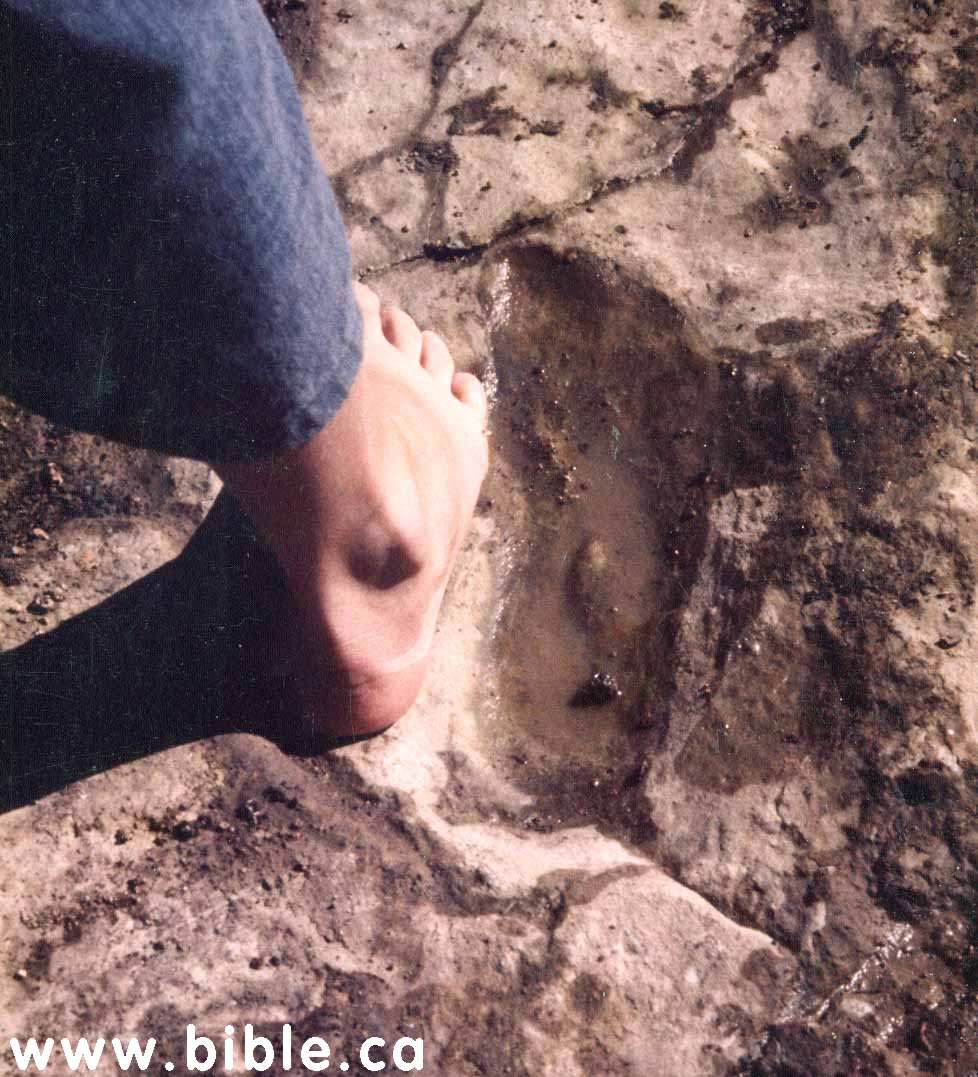
The depression in the limestone was clearly made by a large human foot. It was a right foot. The big toe and three rightmost toes made very clear impressions and rock ridges were found between the toe marks. The second toe made a lesser impression which is consistent with the way humans walk. There was a rock bump in front of each of the toes made when they pushed up the mud. The shape fit the arch and also the right side of a foot. The heel was not clear but looked as if the individual had slid in the mud. The depth of the impressions was consistent with the depth of tracks made by someone walking in mud. The toes were round and smooth. Everything was in the proper proportion.
Since I had the largest foot in attendance, size 13, my bare foot was used as a comparison for the extensive video tapes and photographs that documented the excavation. As my foot was both beside the footprint and in it for quite a while, I was able to examine it very closely.
Without any doubt, it was a human footprint.
I testify that everything I witnessed I have reported faithfully and without exaggeration.
M. Coppedge
I knew that the human footprints, found side by side with dinosaur tracks, if genuine, destroyed the theory of evolution all by themselves. Still, I wanted to see for myself. See agoracosmopolitan.com
Along with two of my friends, Ted and Jorge Gomez, I went to Glen Rose to observe and participate in an excavation on
Jorge and I returned to work on another site on June 29, 1995. This site was about
When we arrived Dr. Baugh was beginning to carefully excavate clay from a depression in the target limestone. Several of us worked with hand trowels to remove the 3-
Once he suspected that the depression on which he was working could possibly be a human track, all other activity in the area ceased. Everyone then focused their attention on his work. Dr. Baugh removed the clay with utmost care and no chipping or sculpting occurred. Several of those in attendance testified to this on camera and that the site was previously unexposed or disturbed in any way. The rock ledge and clay had completely covered the depression until we removed them.
The depression in the limestone was clearly made by a large human foot. It was a right foot. The big toe and three rightmost toes made very clear impressions and rock ridges were found between the toe marks. The second toe made a lesser impression which is consistent with the way humans walk. There was a rock bump in front of each of the toes made when they pushed up the mud. The shape fit the arch and also the right side of a foot. The heel was not clear but looked as if the individual had slid in the mud. The depth of the impressions was consistent with the depth of tracks made by someone walking in mud. The toes were round and smooth. Everything was in the proper proportion.
Since I had the largest foot in attendance, size 13, my bare foot was used as a comparison for the extensive video tapes and photographs that documented the excavation. As my foot was both beside the footprint and in it for quite a while, I was able to examine it very closely.
Without any doubt, it was a human footprint.
I testify that everything I witnessed I have reported faithfully and without exaggeration.
M. Coppedge
Plaster
casts of similar footprints found in Australia Bathurst 25 pounds , implements which only men of
tremendous proportions could possibly have made and used. Estimates for the
actual size of these men range from 10 to 12 feet tall and over,
weighing from 500 to 600 lbs .
A fossicker searching the Winburndale River north of Bathurst discovered a large quartzitised fossil human molar tooth, far too big for any normal modern man. A similar find was made near Dubbo, N.S.W.
Prospectors working in theBathurst
Even more impressive were fossil deposits found by naturalist Rex Gilroy aroundBathurst 6
feet (2 m )
below the surface a fossil lower back molar tooth measuring 67 min. in length
by 50mm. x 42 mm .
across the crown. If his measurements are correct, the owner would have been at
least 25 ft .
tall, weighing well over 1,000
lbs !
AtGympie , Queensland 10 feet
tall.
In the Megalong Valley in the Blue Mountains NSW, a Mr P. Holman found in ironstone protruding from a creek bank the deeply impressed print of a large human-like foot. The print was that of the instep, with all 5 toes clearly shown. This footprint measures7
inches across the toes. Had the footprint been complete
it would have been at least 2
feet (60
cm in length, appropriate to a 12 foot human. However, the
largest footprint found on the Blue Mountains
must have belonged to a man 20
feet tall!
A set of 3 huge footprints was discovered near Mulgoa, south of Penrith, N.S.W. These prints, each measuring2
ft long and 7 inches across the toes, are 6 ft . apart, indicating the
stride of the 12 ft .
giant who left them. These prints were preserved by volcanic lava and ash flows
which "occurred millions of years" before man is supposed to have
appeared on the Australian continent (if one is to believe the evolutionary
theory):
Noel Reeves found monstrous footprints near Kempsey, N.S.W. in sandstone beds on theUpper Macleay River 4
inches (10cm) long and the total toe-span is 10 inches (25cm) —
suggesting that the owner of the print may have been 17 feet tall.
It is certain the Aborigines were not the first to reachAustralia New Guinea
Aborigines themselves admit in their ancient folklore that this land was inhabited by several groups of men, as well as giants, before they settled here.
A fossicker searching the Winburndale River north of Bathurst discovered a large quartzitised fossil human molar tooth, far too big for any normal modern man. A similar find was made near Dubbo, N.S.W.
Prospectors working in the
Even more impressive were fossil deposits found by naturalist Rex Gilroy around
At
In the Megalong Valley in the Blue Mountains NSW, a Mr P. Holman found in ironstone protruding from a creek bank the deeply impressed print of a large human-like foot. The print was that of the instep, with all 5 toes clearly shown. This footprint measures
A set of 3 huge footprints was discovered near Mulgoa, south of Penrith, N.S.W. These prints, each measuring
Noel Reeves found monstrous footprints near Kempsey, N.S.W. in sandstone beds on the
It is certain the Aborigines were not the first to reach
Aborigines themselves admit in their ancient folklore that this land was inhabited by several groups of men, as well as giants, before they settled here.
Fossilised human footprints have also been discovered in Sweden, and in Mexico .
Giant skeletons have been discovered throughout the
Photos of giants from recent times.
An article from Strand magazine (December,1895) reprinted
in "Traces of the Elder Faiths of Ireland" by W.G.
Wood-Martin mentions this fossilized giant discovered during mining
operations in County Antrim, Ireland: "Pre-eminent among the most
extraordinary articles ever held by a railway company is the fossilized Irish
giant, which is at this moment lying at the London and North-Western Railway
Company's Broad street goods depot, and a photograph of which is reproduced
here. . . This monstrous figure is reputed to have been dug up by a Mr. Dyer
whilst prospecting for iron ore in
|
The Original Sin 1/3
The Original Sin 2/3
The Original Sin 3/3
But the Woman being deceived, was in the Transgression
The seed of the serpent produced Cain. If his daddy was a great big giant of a fellow, what would Cain be like? His daddy. And he went to the land of Nod and took one of his sisters. Only way he could, there were no other females. . .
Cain went to the land of Nod, and produced giants. They were smart educated, intelligent people. Is that right? They were builders, inventors, scientists: Not through the seed of the righteous, but through the seed of the serpent. They were scientists, builders, and great men, educators; the Scripture says so. They worked brass; they worked iron; they worked metals. They invented things. They tempered different metals and built houses.


And they were scoffers at the seed of the woman: Noah, the righteous. Jesus said, "As it was in the days of Noah, so will it be when the Son of man is revealed." That's today. And it is so. Genesis 6:1-4, "And it came to pass, when men began to multiply on the face of the earth, and daughters were born unto them, that the sons of God saw the daughters of men that they were fair; and they took them wives of all which they chose. And the LORD said, My spirit shall not always strive with man, for that he also is flesh: yet his days shall be an hundred and twenty years. There were giants in the earth in those days; and also after that, when the sons of God came in unto the daughters of men, and they bare them children who became mighty men which were of old, men of renown."
". . . daughters of man . . ." signifies the MORTALITY of the serpent seed in contrast to the immortality of the sons of God. Their EARTHLY origin is contrasted with the heavenly origin of the "Sons of God," created in the likeness of Father God by His spoken Word. The "daughters of man" are Cain's race, the earthly, carnal offspring of the Satan-incarnate Serpent, they are hybrid and not a spoken Word of God's creation.
The phrase, "came in unto" refers in this connection only to the male who visits a woman's quaters and describes the immorality of "free love" which has repeated in this day along with miscegenation between the descendants of Cain and the children of Adam as Jesus foretold and lauded as "multiculturalism" (Genesis 30:16; 38:16; Matthew 24:37; Luke 17:26-27).
"Men of renown" speaks of men with an enduring name. Genesis describes these people as great builders and engineers, musicians, inventers, craftsmen, unbelievers and scoffers at the righteous of Adam's race. The same race are renouned in these occupations today. Undaunted by the Flood their descendants declare " . . .let us make us a name . . ." and erect a tower in carnal defiance of the Lord God.
The Hebrew word "Nephilim" is rendered "giants" in our English Bibles, but the form of the word indicates a verbal adjective or noun of passive or neuter signification, from Naphal, "to fall" and means "the fallen ones," that is, the descendents of Cain. Afterwards the term is transferred to their offspring, the only other passage in which it occurs.
In their evil report of the
It was doubtless the mention of the great stature of these men, together with the Septuagint rendering that suggested our translation "giants." However the roots of the Greek word, have no reference to great stature and signify "earth-born". The meaning of "giants" in our sense of the term is secondary, arising from the fact that these beings of mixed birth are said to have displayed a monstrous growth and strength of body.
God commanded Moses to exterminate the whole race of these people from the
The Lord Jesus said, ". . . the children of this world are in their lineage wiser than the children of Light" (Luke 16:8).
Paul wrote, "Mortify therefore your members which are upon the earth; fornication, uncleanness, inordinate affection, evil concupiscence, and covetousness, which is idolatry: for which things' sake the wrath of God comes on the children of disobedience" (Colossians 3:5-6).
Immediately after the commission of the antediluvian sin, God pronounced the doom of the world. And prophecy assures us the present-day great rebellion will call forth the Lord Jesus in flaming Fire to take vengeance. Only those whose Names are written on the Lamb's Book of Life will not be deceived—the Bride of Christ manifesting the sons of God, and the 144,000 elect Israelites who are Israelites of the flesh and of the faith.